The Livenza springs, among karst rock, ancient memory and Isabella Cortese's secret refuge.
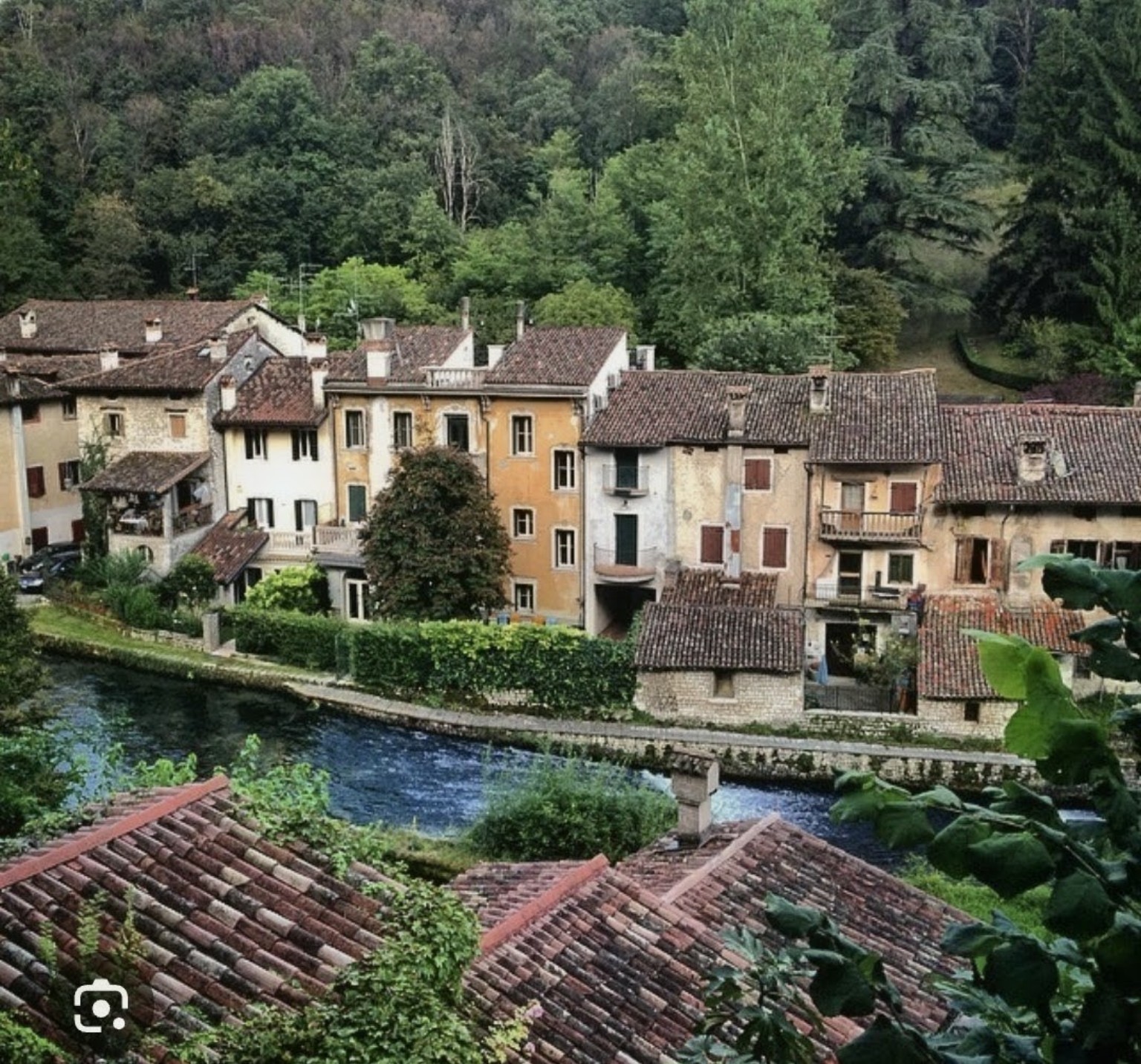
Polcenigo is listed among Italy's Most Beautiful Villages and lives within a landscape shaped by springs. At the foot of the Cansiglio plateau, water filtered through the carbonate massif resurfaces at Santissima and Gorgazzo; further south, towards Caneva, the Molinetto spring area completes this extraordinary karst-water landscape.
Gorgazzo, locally known as el buso, is an exceptionally deep vauclusian spring. Cave divers have explored it down to 222 metres. Its shifting blue tones also fascinated the nineteenth-century painter Luigi Nono.
At Santissima, water emerges from several springs beside the sanctuary. Nearby lies Palù di Livenza, a prehistoric pile-dwelling site included in the UNESCO World Heritage List since 2011.

The FAI I Luoghi del Cuore entry for the Santissima describes a perennial spring fed by the limestone massif of the Cansiglio Prealps. The emergence is concentrated in such a small area that the many springs seem to merge into a single large mouth; the water gushes along a semicircular line and immediately gathers to give body to the Livenza.
Around the spring are the Church of the Holy Trinity, footbridges and nature paths, and a disused small power station. The FAI entry also recalls the ancient connection of the site with the cult of spring water and fertility. This relationship between water, stone, devotion and memory makes the Santissima especially close to the imagery of the novel.
Territorial source: FAI – I Luoghi del Cuore, “La Santissima” entry.
The FAI I Luoghi del Cuore entry for the Santissima describes a perennial spring fed by the limestone massif of the Cansiglio Prealps. The emergence is concentrated in such a small area that the many springs seem to merge into a single large mouth; the water gushes along a semicircular line and immediately gathers to give body to the Livenza.
Karst springs gathering beside the sanctuary, a place repeatedly named in the novel.
A blue liquid abyss explored to a depth of 222 metres and one of the area's most remarkable geosites.
An archaeological landscape inhabited since prehistory and part of the UNESCO World Heritage network since 2011.
In La Resa dei Conti nel Giardino della Serenissima, Isabella reaches Polcenigo after fleeing Sacile and disappears into a discreet network connected to the Diocese of Concordia. Her refuge becomes a house overlooking the springs, near the church of Santissima.
Here she changes identity. She becomes Maddalena da Polcenigo, lives as a healer and uses Livenza water to distil plant spirits, prepare elixirs and treat local people. Maria and Lucrezia share the house with her while the village slowly begins to suspect that this woman knows far more than herbs.
Gold betrays her. Impossible ornaments and traces of transformed metal lead the Illegitimate to the springs. In the cellar he finds blackened iron, golden flakes and the remains of experiments, enough to understand that Isabella truly worked there.
Santissima is not merely scenery. The novel places Isabella's home among the springs, close to the church and the small convent.
When she flees towards Sacile, she takes a hidden path behind the mill, a precise detail that binds the real landscape to the movement of the characters.
Identifying the fictional house with a specific present-day ruin remains literary geography, not a documented historical fact. The page therefore keeps the real place and its fictional transformation clearly separate.
In the author’s narrative geography, the old mill at the Santissima becomes the physical reference for Isabella’s house. This is not a historical claim about the building: it is a literary choice that overlays the alchemist’s imagined home onto a real place crossed by water.
The narrative section comes from the novel manuscript; historical and geographical information is kept distinct from fiction.
Here the journey changes element. After stone, castles and fortresses comes water: spring, medicine, hiding place and clue. Geography becomes part of the plot.