The Queen
Caterina Cornaro came to Asolo after her abdication in 1489. Her presence left a political and cultural memory that remains central to the town's identity.
A place of Renaissance culture and Venetian memory. A real court, a literary landscape and, five centuries later, a new narrative shadow.
In 1489, Caterina Cornaro, Queen of Cyprus, abdicated in favour of the Republic of Venice and received the lordship of Asolo. She lived here with her court into the early sixteenth century, helping turn the town into a refined and culturally vibrant centre.
The Castello della Regina Cornaro, whose origins the Municipality of Asolo traces back to the tenth century, hosted Caterina and her court. Among the figures associated with this milieu was Pietro Bembo, who set the dialogues of Gli Asolani in Asolo. The work was published in 1505 and imagines its conversations within the queen's courtly setting.
Asolo Cathedral also preserves a 1491 baptismal font bearing Caterina Cornaro's coat of arms, commissioned by the queen from Francesco Graziolo.
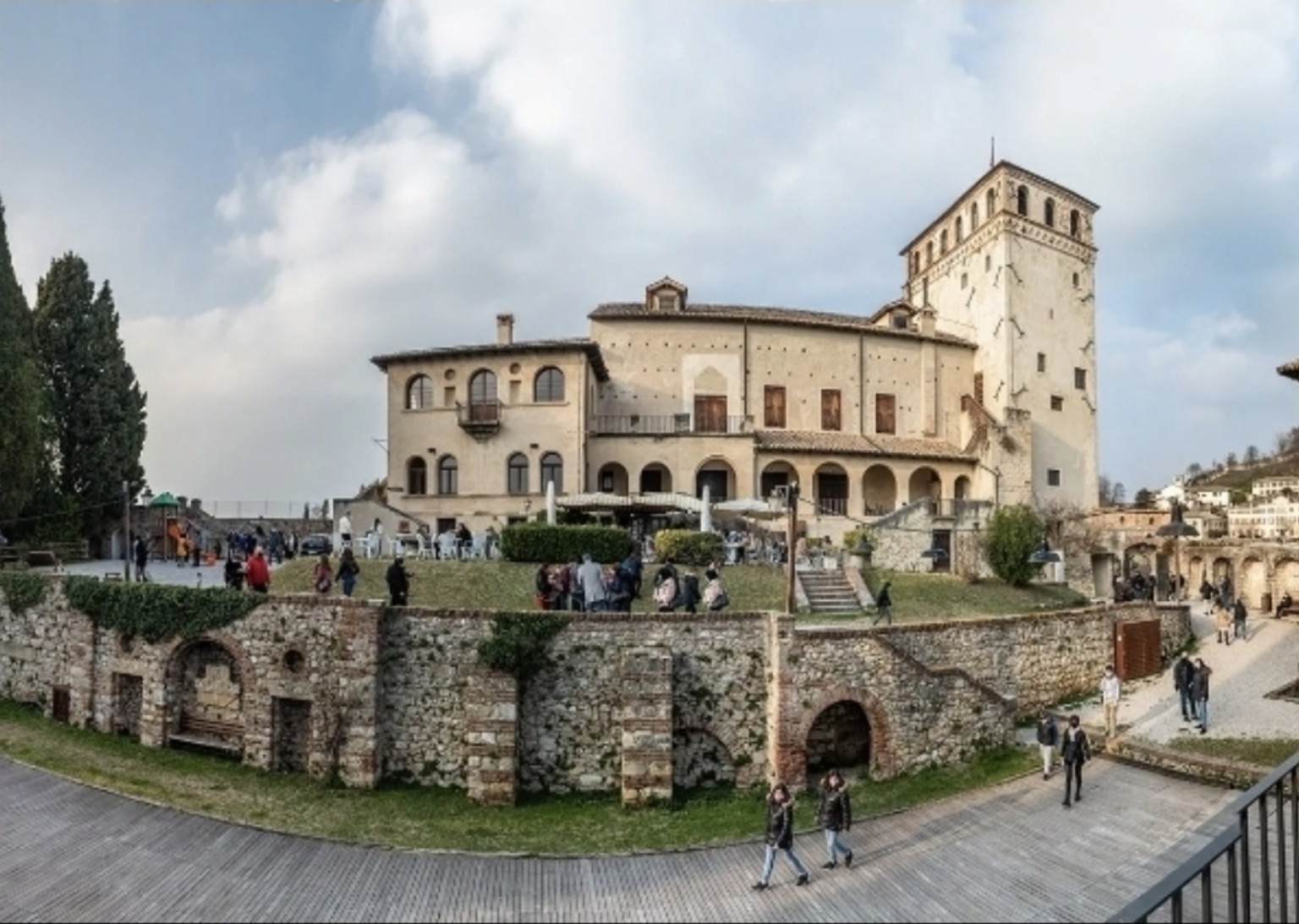
Caterina Cornaro came to Asolo after her abdication in 1489. Her presence left a political and cultural memory that remains central to the town's identity.
Pietro Bembo chose Caterina's court as the setting for dialogues on love that became one of the emblematic literary works of the Renaissance.
Centuries later Robert Browning linked Asolo to the word Asolando, evoking the pleasure of wandering through the town without haste. Another sign of the place's enduring literary power.
Asolo has the Castello della Regina Cornaro in the historic centre and the Rocca on Monte Ricco. This page keeps the two sites distinct in its historical reconstruction; the novel freely uses Asolo's geography as narrative space.
In the novel La Resa dei Conti nel Giardino della Serenissima, Asolo changes register. Over the luminous memory of the Renaissance court falls the shadow of Flaminio Torriani, known as the Illegitimate: a fallen noble rejected by Venice and Rome who has made the sword his only law.
It is in Asolo that he receives the assignment that triggers one of the novel's darkest arcs: a list of four names to eliminate, including the alchemist Isabella Cortese. And it is within Asolo's fortified landscape that the storyline closes again with his duel against Count Pompilio di Porcia.
Here the fiction is explicit and recognisable. History provides the stone; the novel lays a second memory upon it.
Tambre opens the door to alchemy. Piano d'Arta leads into the Carnia of the Reformation. Asolo takes the journey into the Renaissance memory of the Serenissima. Each stop tells an independent story and, together, they expand the world of the novel.
The Alchemist House: Athanor, symbols, Nigredo, Albedo and Rubedo.
Go to the Tambre stop →Casa Pianese: the Friulian stop between Reformation, Inquisition and Carnic memory.
Go to Casa Pianese →Castello della Regina Cornaro: Renaissance court, Bembo and a new geography for the novel.
Find Asolo on the narrative map →Historical references: Municipality of Asolo, Castello della Regina Cornaro; Museo Civico di Asolo, La storia; Asolo.it, Cathedral; Treccani, Asolani. The sections involving Flaminio Torriani, Isabella Cortese and Pompilio di Porcia are explicitly part of the fictional narrative.